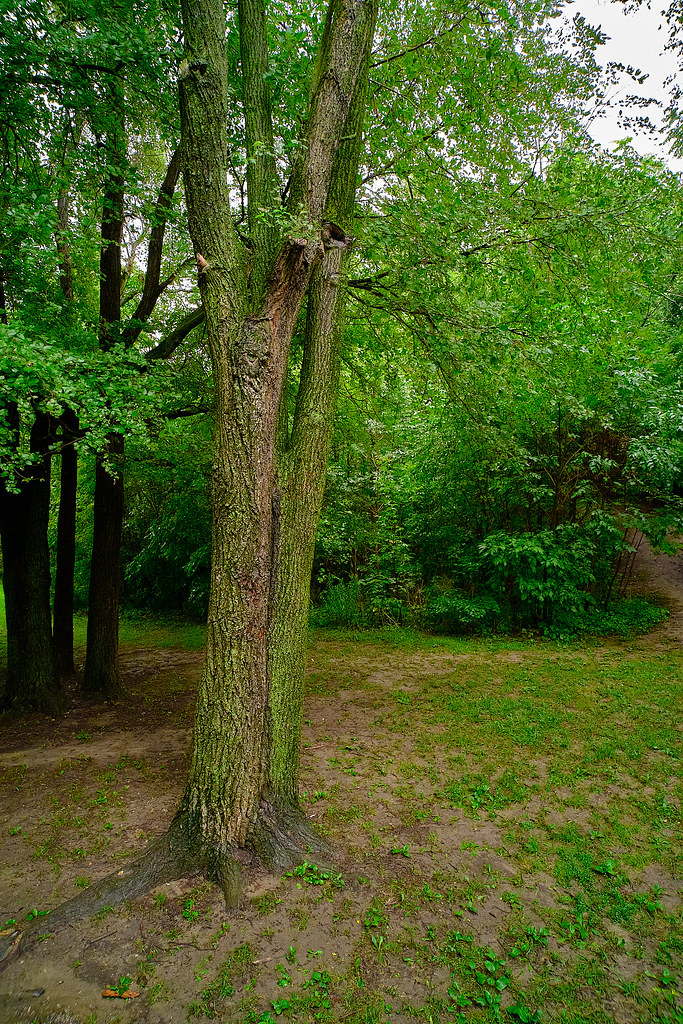
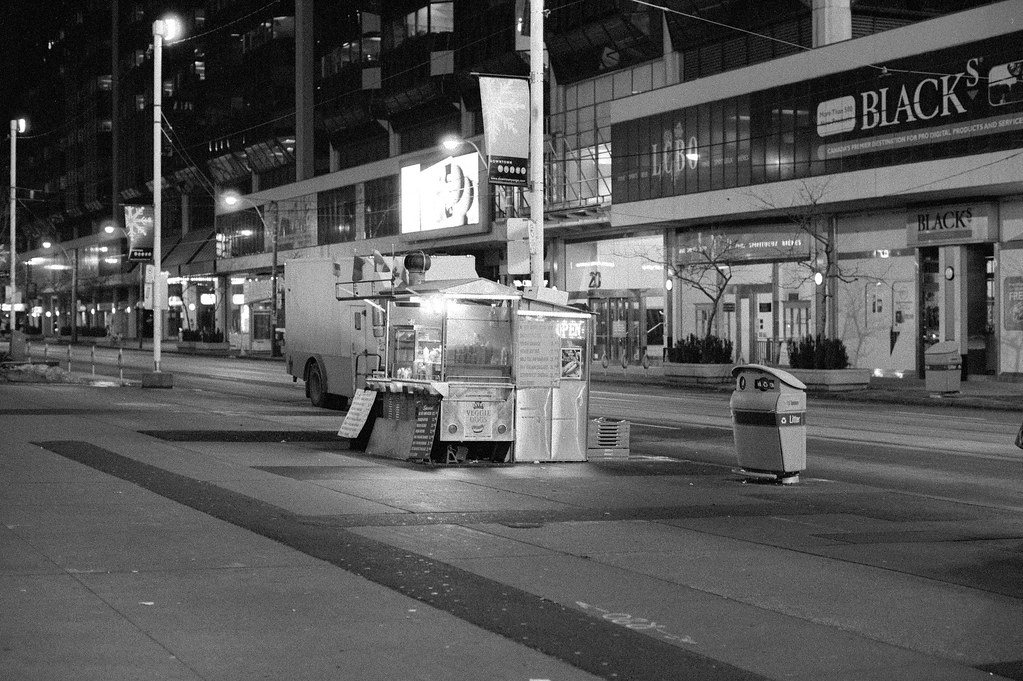
Fujifilm X-T2, 7Artisans 12mm f2.8
I've been adapting vintage lenses to digital cameras since the day I got my first DSLR back in 2005. I love manual focus and manual lenses and I've learned a few lessons the hard way.
Here's a few thoughts.
For APS-C shooters, don't bother adapting anything vintage wider than 35mm, and frankly most vintage 35's aren't worth your time. At 40mm or longer, adapting comes into its own. This goes doubly for Mirrorless, where you pay a significant size penalty for adapting lenses wider than 35mm as compared to simply buying a cheap and native manual focus lens. The issue is that you're already somewhat more dependent on lens speed than a FF shooter and vintage glass wider than 35mm is very rarely faster than f2.8, and when it is it's usually very low contrast wide open. That makes focus all but impossible on DSLR's and merely a pain on Mirrorless. Also most folks just find largish f3.5 normals kinda useless. 50mm and longer? Have fun, 50-200mm in particular is a sweet spot (longer and I find AF just becomes more and more useful for the sort of shooting you'll want 300mm+ lenses for)
For m43 shooters (or the few remaining Nikon 1 shooters). Don't waste your time. The crop factor hits you far worse and frankly anything on either side of the 50-100mm range is just going to suck as a shooting experience. I'd only bother really with macro's, and especially ~100mm ones. The more I shot m43, the more I just left everything vintage except macros at home.
For FF shooters, go nuts. You're not paying any penalty for adapting, especially on mirrorless, that you wouldn't have on the original camera, with one glaring exception. The exception is the use of classic RF wides (or the handful of SLR wides that require MLU to mount) on non-Leica cameras. These lenses have some interesting colour shift issues and require care to use with success.
As somebody who doesn't own much in the way of AF lenses, with one single one for my Fuji's (the XC35mm f2) and only a handful for my D750 (4 in my shooting kit and a spare 50mm) as compared to the 15 or so vintage lenses I own
Sunday, 9 August 2020
Some Thoughts on Adapting Vintage Lenses
Saturday, 8 August 2020
First Real Hike With The X-T2
Fujifilm X-T2, 7Artisans 12mm f2.8
Today was the first time I got a chance to do a real hike with the X-T2, for the last 3 weeks I've only been shooting in the neighbourhood aside from one trip up to Torrance Barrens for Comet Neowise. Today I got out to the Seaton Hiking Tail in Pickering to hike the second segment (Whitevale to Taunton Rd). I did take all 3 Fuji bodies, but only because I was intending to do a family shot of my basic Fuji shooting kit
View this post on InstagramA post shared by Adam Maas (@mawz77) on
Aside from that, I packed the X-T1 also as a backup/second body but ended up shooting everything on the X-T2.
And I shot a lot with the X-T2. 526 shots in fact, on the high side of average for me when hiking. Yes, I shoot a lot. I also edit ruthlessly afterwards. I'm not one of those folks who spends 8 hours hiking and comes home with 5 frames, more the opposite. Of course most of my shots are the nature shots, where I tend to take a lot of similar frames and pick the best, for landscape shots I took maybe 40 frames all day.
That puts the X-T2 well over 1000 frames and well into my comfort zone. Well, to be frank it went pretty much directly from 'New Toy' to 'Comfort' somewhere around 3-400 shots in, with no 'Equivocation' stage. (the stages of camera ownership are from my 1101 Shots In post from 2018). In fact at this point, with 1400+ shots on it, I've shot more with the X-T2 than with any of the Fuji bodies I've owned aside from the X-T1's.
Overall, the X-T2 is really an X-T1 with most of the annoyances solved. And I already like the X-T1 a lot.
For today, I was pleasantly surprised to only use 1 battery all day. Now I pretty much ran it all the way down, but 526 shots is better than I typically got with the A7II and I wasn't doing anything to manage battery beyond turning the camera off when I wasn't using it. Having a properly sized on/off around the shutter helps, making this as easy as on the Sony or Nikon bodies, and better than the X-T1 or X-E2 (which have too small a switch) and far better than the Oly's (which put the switch on the left where it's unreachable). It's not D750 battery life, but this is the second time I've been favourably impressed by the battery life on this body, after the good impression it left at Torrance Barrens a couple weeks ago.
In terms of IQ, I'm finding three things. First off it doesn't expose hot like the 16MP bodies do. So I don't have to worry nearly as much about holding the highlights as I do with them. Secondly I have more recovery room than the 16MP bodies, especially in the highlights but also in the shadows. Third, while the colour signature is very distinctly Fuji, I can get a landscape rendering I like out of it fairly easily, which I never quite nailed with the X-T1 or X-E2. Add to that the fact that CaptureOne natively supports the Film Simulations on the X-T2, unlike on the older bodies (only the 24MP & 26MP Fuji's have Film Simulation support in C1) and my processing goes from more laborious than the Nikons to less so. That's a win overall as it means that rather than having to choose between easy to carry and easy to process, I get all in one package.
In terms of glass, I took the 7Artisans 12mm f2.8, the Laowa 15mm 4 Macro, the Neewer 25mm f1.8, the Fujinon XC 35mm f2, the Micro-Nikkor 55mm f3.5 AI and the Vivitar 70-150mm f3.8 C/Y. I used all the lenses except the Laowa, although the XC35 got barely any use. I should have left the Vivitar at home and carried either the Nikkor 70-300mm f4-5.6D or the Nikkor 50-135mm f3.5 AI-S. I'm not happy with the Vivitar's performance on 24MP APS-C. It does fine on the A7II, but just isn't up to the higher pixel density APS-C sensors unless I stop down to f8, which eliminates the reason to carry it over the 70-300D. For the first half of the walk, I used the 12mm, 25mm and 70-150. On the way back I used the 12mm, 35mm and 55mm, but mostly just the 55mm as I'd got most of the good 12mm shots on the way out.
The takeaways from lens usage is that I could largely get away with the 12mm, another 16-50 and a 50-230 or 55-200 for Hiking, eventually going to the 10-24/55-200 pair (or a 10-24/70-300 pair with a 35-55mm prime in there too, once the XF70-300 arrives). That would let me cut down significant on lens count, which also means I might be able to get away with using my light hydration pack over a camera pack, allowing me more water and a cooler carry (that pack has a mesh section which keeps the main pack away from the back).
I didn't carry a tripod today, knowing it would get no use. I did have the Platypod just in case but didn't need it. I do like having it so I know I have a support system if needed, but without the size & weight penalty of even my smaller tripod.
For next time, I'll carry the 12, 25 and 55, plus either the 50-135 or the Nikkor 105mm f2.5 AI-S. I'm slowly getting the kit down to something truly manageable for longer hikes.
Wednesday, 5 August 2020
7Artisans 12mm f2.8 FX - Initial Impressions
My 7Artisans 12mm f2.8 arrived yesterday, after a surprisingly long wait for an Amazon Prime order (ordered last Friday, man I've become spoiled by next day shipping). This will be my go-to UWA on my Fuji bodies for the foreseeable future.
Initial impressions are very good. My expectations in terms of presentation were for something akin to my Neewer 25mm f1.8, ie a lens in a decent little leather pouch, in a simple cardboard box. The Neewer is a re-branded 7Artisans lens and led me to that conclusion.
What I got was much different. A slick black box with 7Artisans LENS filigreed on it, opened it up to find a lens cloth (nice, but in the listing so no extra points), a slick microfibre lens pouch and a little plastic pouch containing a stick-on focusing tab, plus the lens paperwork (Warranty card and a little manual with some useful bits and some Warm Ticks). Lifting those out finds a removable closed-cell foam insert, which can be removed to find the lens securely cradled in a second closed-cell foam insert, contained in a small plastic bag. Really impressive packaging, better than my Laowa 15mm for sure, and for a lens which sells for 1/3 the price. Frankly, most camera makers do not package their lenses this well, even at far higher costs (my Zeiss 85mm f1.4 came in good old styrofoam)
Taking the lens out of the package, I continued to be impressed. Again, I was basing my expectations on the Neewer/7Artisans 25mm f1.8, which has an OK build, completely uncalibrated focusing and a very grindy focus feel when new (the helical needed to be broken in, it's quite nice now). The 12mm on the other hand has excellent build, just about on par with the Laowa 15mm. Infinity focus appears to be dead-on (and I mean exactly on) and the focusing is buttery smooth, with just the right amount of damping to make the focusing tab a useful add-on. The lens cap is a metal push-on cap that fits over the integrated hood. It's not that wide to not include a filter ring, but 7Artisans sells a 77mm filter adapter as a $25CDN addition, I'll be ordering that eventually and I like that it's optional as this is a surprisingly compact lens without it, barely larger than the XC35/2. The aperture ring is clickless and ranges from f2.8-f16, a little surprising that it doesn't make it to f22 or smaller for those deep-DoF shots. Not an issue for me, I'll pretty much leave it at f5.6 or f8 for the most part.
A couple quick test shots showed that the sharpness is good in the centre at least. Close focus is 20cm, more than adequate for a lens like this, even if I'm spoiled by the Laowa 15mm and its 1:1 close focus. No flare/coating tests yet, and I expect that to be the biggest weak point of this lens, I have lenses from 4 different Chinese brands and 3 different factories (Laowa, 7Artisans/Neewer, Yongnuo) and all of them have lousy coatings, even the $500USD Laowa 15mm f4 Macro.
Overall the presentation and quality are far better than I'd expected for a $240CDN Ultra-wide angle lens. Well done 7Artisans.
Tuesday, 4 August 2020
Olympus Underwhelms Again
Olympus had two announcements today, the E-M10 Mark IV and a 100-400 f5-6.3 IS.
Surprisingly, the 100-400 IS will ship in early September. I was not expecting that and this lens should appeal to quite a number of m43 folks looking for a lightweight supertele option that is fully compatible with the advanced focusing features of the 20MP PDAF bodies. It's a little pricey at $1500USD, but no doubt will see discounts fairly quickly. I'd expect it will be hard to get for a while, as this is the perfect match to the 12-100/4 Pro for a lot of backpackers. Say what you will about the bodies, but Olympus is now 2 for 2 on interesting lenses in 2020 with the 12-45/4 (after a 2 year dead zone in 2018 & 2019, where they announced 2 lenses and delivered only one of them, a thoroughly uninteresting consumer ridicuzoom, we're still waiting for the 150-400/4.5 that I frankly never expect to see released at this point)
On the body side Olympus managed to undershoot my already low expectations. I'd expected it to be nothing more than the 20MP sensor and processing stuffed into an E-M10 III body. Olympus delivered that, but they used the Pen-F variant of the sensor without PDAF rather than the PDAF variant that's used in all their current 20MP bodies, so despite the speed boost (up 1.5fps to a still-low 6.3fps) and gaining face/eye detection it remains utterly worthless for continuous advance or movie AF. It also got a Nikon Z50 style extended articulation of the LCD so you could use it for hand-held selfies, but not any where you are using camera support. On the plus side, it has a very reasonable 360 shot CIPA rating for LCD use, that's better than average for a class where sub-300 shots is not unheard of.
The pricing would have been alright if the body had been what I'd originally expected, coming in at the same pricing as the X-T200 ($699USD body-only, $799 with 14-42 EZ kit lens). But without PDAF this is a $500 stripper body in this market, with performance on par with the Fuji X-T100 and Sony A6000 and as such it's about $200USD overpriced for what it is.
Verdict? Don't buy at list, if you really want it wait for the fire sale in 3 months. Or better yet, get the E-M5III when it hits fire sale territory as it's just a massively better body in all regards, even at its current wildly overpriced state.
Friday, 31 July 2020
The Ever-Present Lure of Film

Film continues to be an interest of mine. While I've pretty much stopped shooting it for the last few years, I'm always tempted to come back to it. I've dabbled enough over the last few years that I do still have a backlog of film to process.
There's a few reasons for this.
First off, I like the cameras and process of shooting film. Manual, mechanical 35mm cameras in particular are just so very enjoyable to use. It's not surprising that I currently shoot the digital system that's closest to a classic Nikon film SLR in UI (Fuji that is, the X-T line is the closest thing ever done to a digital FM2n). I also like classic manual focus lenses. Unsurprising that the vast majority of my lenses even today are manual focus classics. They're just my bag.
Second I like the results. Film just looks good, we've been exposed to the look for so long that it's how we expect photographs to look. This is why Fuji's film simulations are so popular and why there's a big market for film mimicing presets and plugins for post-processing. This is especially true for B&W work, but of late we've seen a lot of attempts to mimic classic films like Kodachrome or Portra. Some of these were even successful (Fuji's Classic Chrome for example is clearly a Kodachrome simulation)
Third, I still do like the process, especially in the case of B&W. While I know find the workflow more problematic than I do for digital, the art of developing remains a meditative experience for me.
The odd thing is that I've never really liked shooting landscapes with film however I've always preferred film as a cityscape medium. That does explain a lot about my move away from shooting film as I've transitioned from primarily shooting Cityscape to primarily shooting Landscape & Nature.
I really do need to get out and shoot some film. I also should really acquire a second Nikon body so I can load one with colour and one with B&W. I do find having only one body limiting in terms of film choice.
Thursday, 30 July 2020
What Should Nikon Do?

5. Folks shoot DX because it's small and/or they like the reach it brings. For the former, small bodies combined with lenses like the 24-50 cover it. For the latter, Nikon needs some cheap and long lenses. A consumer 200-500/8 would work well here. Canon's F11 telephotos are their answer, Nikon needs its own answer. A small and cheap set of primes are also needed. 18 & 24 f2.8's, 35, 50 and 75 f2's. These need to be good performers, but not S level, and should sell between $150 and $400 USD. That fills the compact needs and the cheap needs, while still delivering solid performance. Fuji's Fujicron line is the pattern here, but without the fancy build that drives up the price.
This does need to be paired with a USB-C version of the remote release cable, but that's really it. By pairing this way, Nikon can support a larger selection of accessories while minimizing the hardware cost. USB-C can support HDMI output, audio in/out, power delivery, remote releases, external storage, tethering, etc. And thanks to being a USB variant, it can do all of those at once via hubs.
One thing that should definitely be supported is the ability to write to USB-C storage directly, with support for typical filesystems (FAT32, ExFAT, NTFS and whatever Mac OS is doing these days). More capability with less hardware is a win for everybody. The users get more camera and it costs Nikon less to deliver.
Where possible, any USB-C capability added should be given to all bodies in the line.
Wednesday, 29 July 2020
Film Simulations on Your Nikon
Fuji gets a LOT of love, and deservedly so for their Film Simulations, one of the signature features of the X and GFX camera lines.
Nikon on the other hand has delivered a more powerful capability starting with the D3 & D300, and left it largely ignored and poorly documented.
Fuji put a lot of time and effort into developing their Film Simulations, but there remains a lot of customization that Fuji users have done, and have traded recipes online. Sadly you can't simply export a recipe and share it with others, you can only document your settings.
Nikon on the other hand has stuck with a set of generic Picture Controls, their name for the various JPEG settings that you can pick when shooting Nikon. Far more poorly known is the fact that you can load anywhere from 3 to 9 custom Picture Controls onto your compatible Nikon camera, in addition to being able to edit the Picture Controls using the Nikon Picture Control Utility 2 app on your PC or Mac. And the camera can also edit and export Picture Controls.
There is at least one public repository of Picture Controls, along with an online editor at https://nikonpc.com/ and this one included many similar options to the Fuji ones (Kodachrome 2 should match up with Classic Chrome). You can download from there and then import them on your camera directly by putting the files in a folder on the card called NIKON\CUSTOMPC\ or use the PCU2 app to manage them and write the ones selected to the card.
Why Nikon hasn't done anything more with this amazing feature, I don't know. It would be well worth them licensing some classic film names (I'm sure Kodak's remains would happily license their brands to Nikon for a reasonable cost).
The only downside is custom Picture Controls are only respected by Capture NX-D right now, and who wants to actually use that, so unlike Fuji's Film Simulations, they're less useful for the RAW shooter (although there may be some support coming in CaptureOne now that they have an official Nikon variant)